AGVs ensure fast deliveries
Tackling time pressures in online retail with automated transport: At the Hermes logistics centre in Löhne, Germany, two separately managed subsidiaries of the Otto Group collaborate on delivering large-volume consignments to online buyers. These consumers are impatient, expecting their deliveries in the shortest possible time. Mobile robots from the Austrian manufacturer Melkus Mechatronic handle the transport to the lorry loading area across both companies and a connecting corridor. This automation measure ensures reliable deliveries with short handling times, hence safeguarding the logistics providers’ competitiveness.
Consumers selecting the items they are looking for in online catalogues and placing orders electronically within a few minutes are not prepared to wait days or weeks for delivery. This expectation has been placing stricter demands on the logistics behind the process.
Complex warehouses for large consignments
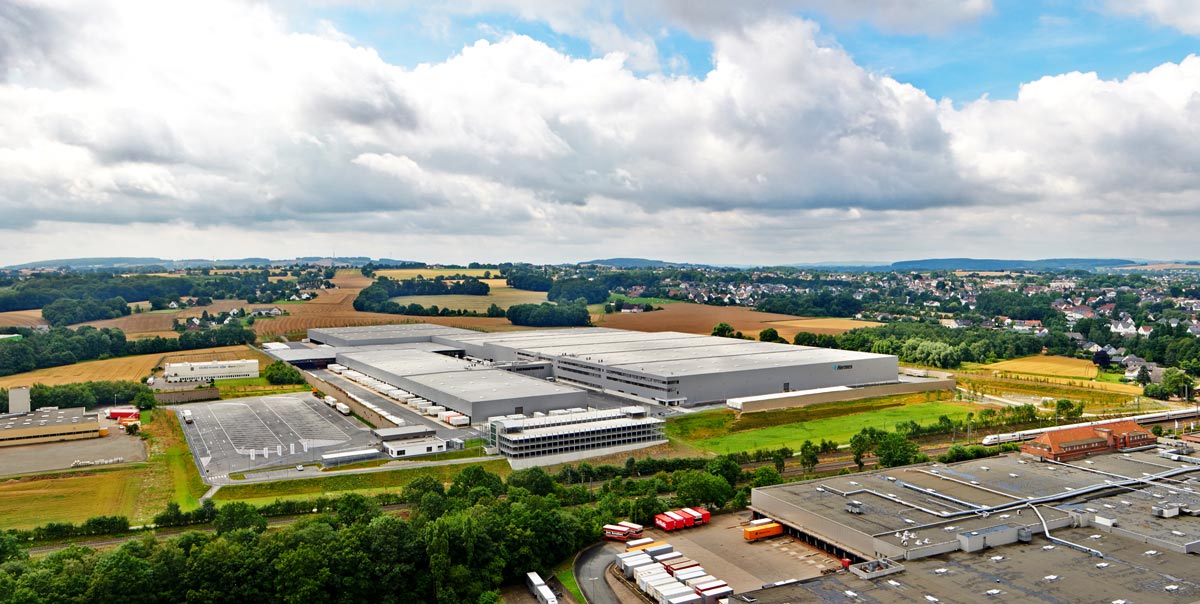
The Otto Group operates a huge logistics centre in Löhne (North Rhine-Westphalia, Germany) for the storage of bulky goods, such as domestic electrical appliances or furniture, destined for delivery to consumers in Germany and Central Europe. Both structurally and organisationally, this centre comprises two closely cooperating units, operated by Hermes Fulfilment (HF) and Hermes Einrichtungs Service (HES), both of which are wholly-owned subsidiaries of the Otto Group.
The 680 employees work across 100,000 m² of warehouse space with 128 lorry loading bays. They process more than four million orders annually and load just as many large-volume consignments onto lorries. HF operates the distribution centre and also handles returns. From HES’s main transhipment hub (HUB), end customers are supplied with goods that come from the HF distribution centre or are channelled through directly from incoming shipments.
Customer expectations drive push for automation
Delivered products are stored in HF’s twelve-metre-high wide-aisle high-bay warehouse. A pull-type warehouse is also available there for fast-moving or particularly bulky items. After being retrieved from storage, the picked consignments are made ready at the designated lorry bay in HES’s adjacent main transhipment centre (HUB). In the process, the consignments travel a distance of 200 to 600 metres.
In the past, these movements were carried out exclusively by hand, using motorised pallet trucks or manned forklift trucks. It was clear to management that, despite its enormous size, the Hermes logistics centre would reach the limits of what was feasible in the not-too-distant future. The ever-increasing demands in terms of volumes and turnaround times cannot be met with the existing workforce, and it is not easy to recruit additional staff for these tasks.
Hermes therefore decided to automate this internal transport process across both companies. An automated guided vehicle (AGV) system was to take over these transport operations, relieving the Hermes team of this arduous, repetitive task and freeing them up for other duties. This was intended to enable Hermes to increase the number of transport operations per day, reduce turnaround times and, furthermore, make the process more consistent.
A clear requirement specification
The requirements for the AGV system presented a challenge. A key objective was to transport 1,000 consignments per day, each with a total weight of up to 1,000 kg. The goods are placed on standard Euro pallets (800 x 1,200 mm), large pallets (1,600 x 1,400 mm) and 1,200 x 1,150 mm metal mesh baskets for transporting furniture, known as ‘Corlettes’. These had to be reliably located and picked up within a 200 mm tolerance range.
The transport routes between 220 staging areas and 128 lorry lanes, some up to 600 metres long, necessitated a correspondingly large fleet. Transport from the collection point to the correct lorry loading bay must be carried out reliably, despite the often large and heavy loads with an off-centre centre of gravity. Another challenge is ensuring the reliable operation of the control system and the Wi-Fi-based communication with the vehicles across two companies.
Safe mixed operation required
The transport routes run through two warehouses and the connecting corridor. In mixed-traffic operations, they are used not only by AGVs but also by forklift trucks and pedestrians – in other words, by people. For this reason, Hermes required the automated guided vehicles (AGVs) to ensure uncompromising personal safety.
Moreover, some steps in the process still need to be carried out manually: goods receipt, quality assurance, goods storage, preparing goods at the handover point, scanning the picked goods and, finally, loading the lorries. That is why Hermes informed and involved the workforce at an early stage. Through direct communication, the employer was able to address employees’ questions openly and foster acceptance of the new robotic ‘colleagues’.
A smart approach
The project was highly complex, not least due to its scale. Melkus Mechatronic won Hermes over with a holistic concept. As a first step, this involved a precise definition of the transport processes and their conversion into an automated system. In doing so, unplanned activities were also taken into account as far as possible and integrated into the process.
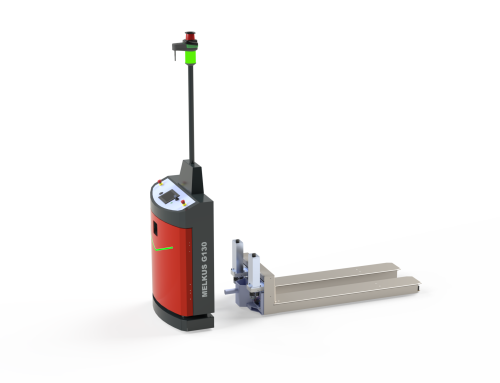
The standardised vehicle selected is the Melkus G130 pallet AGV. “This AGV can carry a payload of up to 1,200 kg,” explains Dominik Schnitzinger, head of software development and customer support at Melkus Mechatronic. “By positioning itself autonomously in front of the pallet, it picks up the load with extreme precision and speed.”
Thanks to its omnidirectional drive system, the AGV is fully manoeuvrable in all directions. State-of-the-art 360° laser scanners enable it to scan the surroundings and the load, as well as reliably recognise pallets. Together, this enables the AGV to position itself autonomously in front of the pallet to be picked up without the manoeuvring movements otherwise required. This autonomous positioning ensures accurate and time-saving load handling in confined spaces, thereby contributing significantly to achieving the objectives of shortening the overall process.
The 360° sensor system is a key feature of the Melkus G130. It is used for SLAM navigation and provides reliable protection against collisions with unexpected obstacles and other vehicles, but above all with people. In this way, the scanners ensure safe and smooth mixed-traffic operation in the aisles of the logistics centre.
Extensive AGV fleet
The fleet consists of 28 AGVs, of which HF operates 25 and HES three. A high-performance control system coordinates the fleet, allocates tasks and manages them. It displays in real time which AGV is currently travelling where. The driverless transport vehicles communicate with the control system via Wi-Fi. “In addition to the different shift patterns, warehouses and loading aids, we also had to ensure that the control system prioritised urgent orders,” explains Marc-Andre Münstermann, logistics planner at Hermes Fulfilment GmbH.
The Melkus AGV transports the pallet to the destination position specified via the VDA5050 interface. “At the HES-HUB, there are 128 different lorry lanes, each approximately 2.2 metres wide and 15 metres deep,” says Hakan Sanal, Supervisor of Warehouse Outbound & Facility Management at Hermes Einrichtungs Service GmbH & Co.KG, describing the handover process. “We are still in the introductory phase, but we can already see great potential in the Melkus G130. We hope that the full roll-out will, above all, bring greater reliability and punctuality to our processes.”
The high-performance LiFePO4 battery in the Melkus G130 2.0 enables continuous operation for over four hours. The AGVs automatically navigate to the 20 stations installed at Hermes for contact-based fast charging. The fleet management software determines when charging breaks are taken, depending on the vehicles’ needs and availability.
1,000 pallets a day
“Our initial situation was highly complex, the list of requirements for an automated guided vehicle system was long, and expectations were high,” explains Marc-Andre Münstermann. “Given the size and complexity of the overall system, we chose the experienced Austrian AGV manufacturer Melkus Mechatronic.”
The AGV system has significantly reduced the workload on Hermes staff, and the integration of the AGVs has been a success. Thanks to the deployment of the Melkus AGV fleet, 70 per cent of all internal transport operations at the Hermes logistics centre in Löhne, approximately 1,000 pallets per day, have been automated. The only items still transported manually are those that do not fit onto a pallet.
After just one year, the AGV fleet at HES had already been enlarged to a total of 14. There are also plans to make more intensive use of the existing AGVs in the near future. The return transport of empty pallets is also to be automated in order to improve the sustainability of the facility.
Technical specifications: Melkus G130 2.0
- Payload: 1,200 kg
- Speed: 1.5 m/s
- Navigation: SLAM Lidar navigation (+/- 1 cm)
- Dimensions: 1,663 mm x 604 mm x 827 mm (L x W x H) excluding mast
- Signal mast: Standard height 2,235 mm
- Unladen weight: 222 kg
- Lifting height: 240 mm
- Turning circle diameter: 1,704 mm or 1,783 mm with Euro pallet
- Drive system: Omnidirectional
- Fork height: 90 mm
- Fork length: 1,300 mm
Customer
Hermes Fulfilment GmbH, headquartered in Hamburg with sites in Haldensleben, Löhne, Ohrdruf, Ansbach and Langenselbold, as well as in Poland, the Czech Republic, Switzerland and Italy, manages the entire fulfilment process chain for retail companies within the Otto Group and for their platform partners. With a product range of around one million items, the company organises warehousing (storage and packaging) as well as returns processing. Hermes Fulfilment employs around 8,000 staff and handles approximately 500 million items per year.
Hermes Einrichtungs Service (HES) employs around 8,000 staff across its entire network and is the market leader in the delivery of furniture, large electrical appliances and other heavy and fragile goods to end customers. Together, the two companies operate the logistics centre in Löhne (North Rhine-Westphalia). From there, around five million large-volume consignments weighing 31.5 kg or more are dispatched annually to customers in Germany and Central Europe.
Hermes Fulfilment GmbH
Scheidkamp 15
D-32584 Löhne
HERMES Einrichtungs Service GmbH & Co.KG
Albert-Schweitzer-Straße 33
D-32584 Löhne

Marc-Andre Münstermann, logistics planner at Hermes Fulfilment GmbH: “Given the size and complexity of the entire system, we chose the experienced Austrian AGV manufacturer Melkus Mechatronic.”

Hakan Sanal, Supervisor Warehouse Outbound & Facility Management at Hermes Einrichtungs Service GmbH & Co.KG: “We are still in the introductory phase, but we can already see great potential in the Melkus G130. We hope that the full roll-out will, above all, bring greater reliability and punctuality to our processes.”

Dominik Schnitzinger, Head of Software Development & Customer Support at Melkus Mechatronic: “The Melkus G130 pallet AGV, with a payload of up to 1,200 kg, picks up loads extremely accurately and quickly thanks to its ability to position itself autonomously in front of the pallet.”
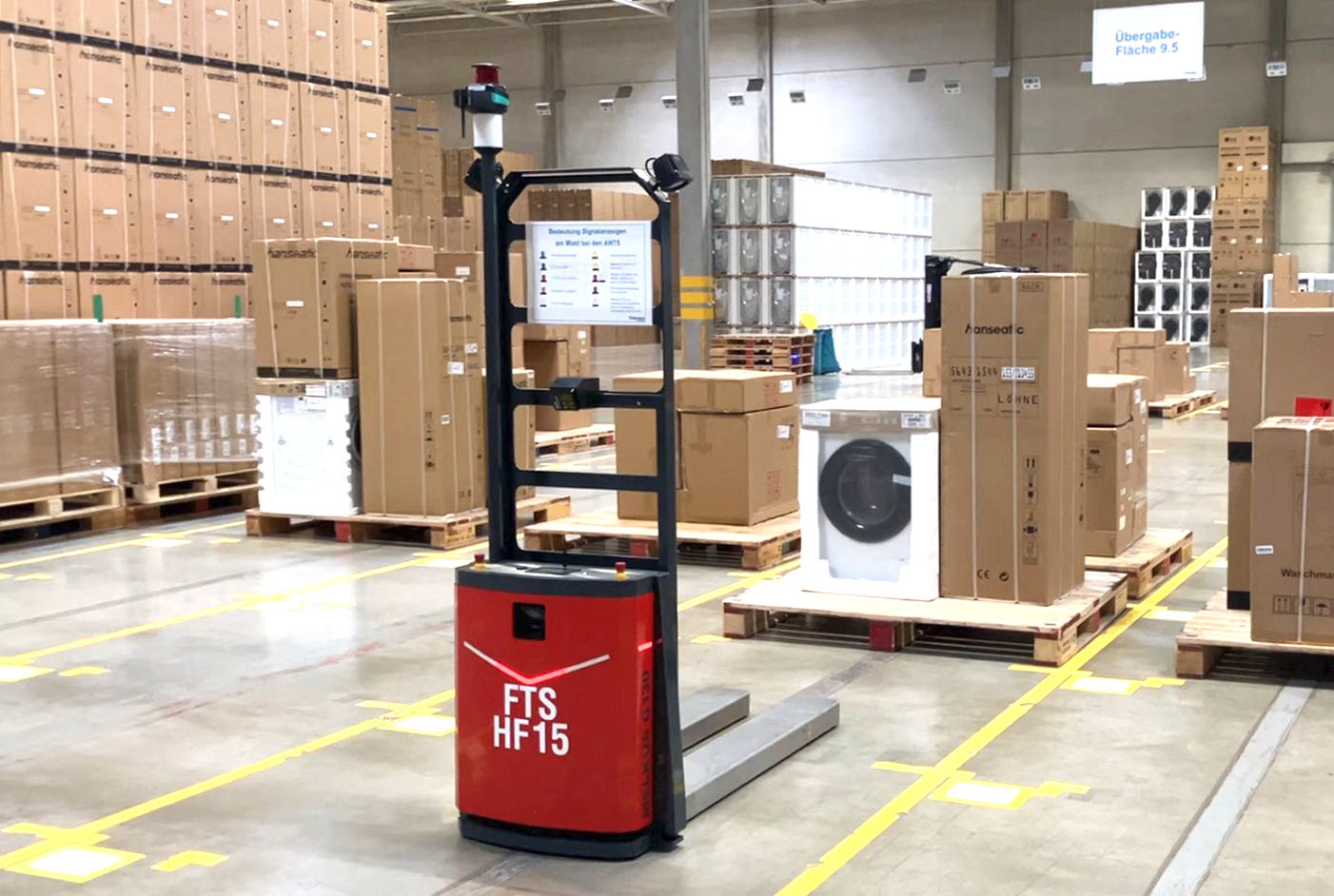
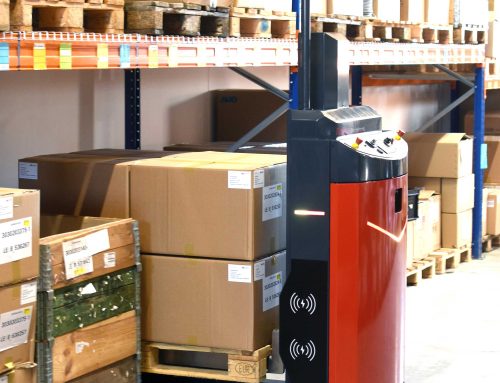
At the Hermes logistics centre in Löhne, Melkus G 130 AGVs transport around 1,000 pallets of picked goods every day over distances of up to 600 metres from 220 collection points to 128 destinations, mainly lorry loading bays.
All images, unless otherwise stated: Hermes
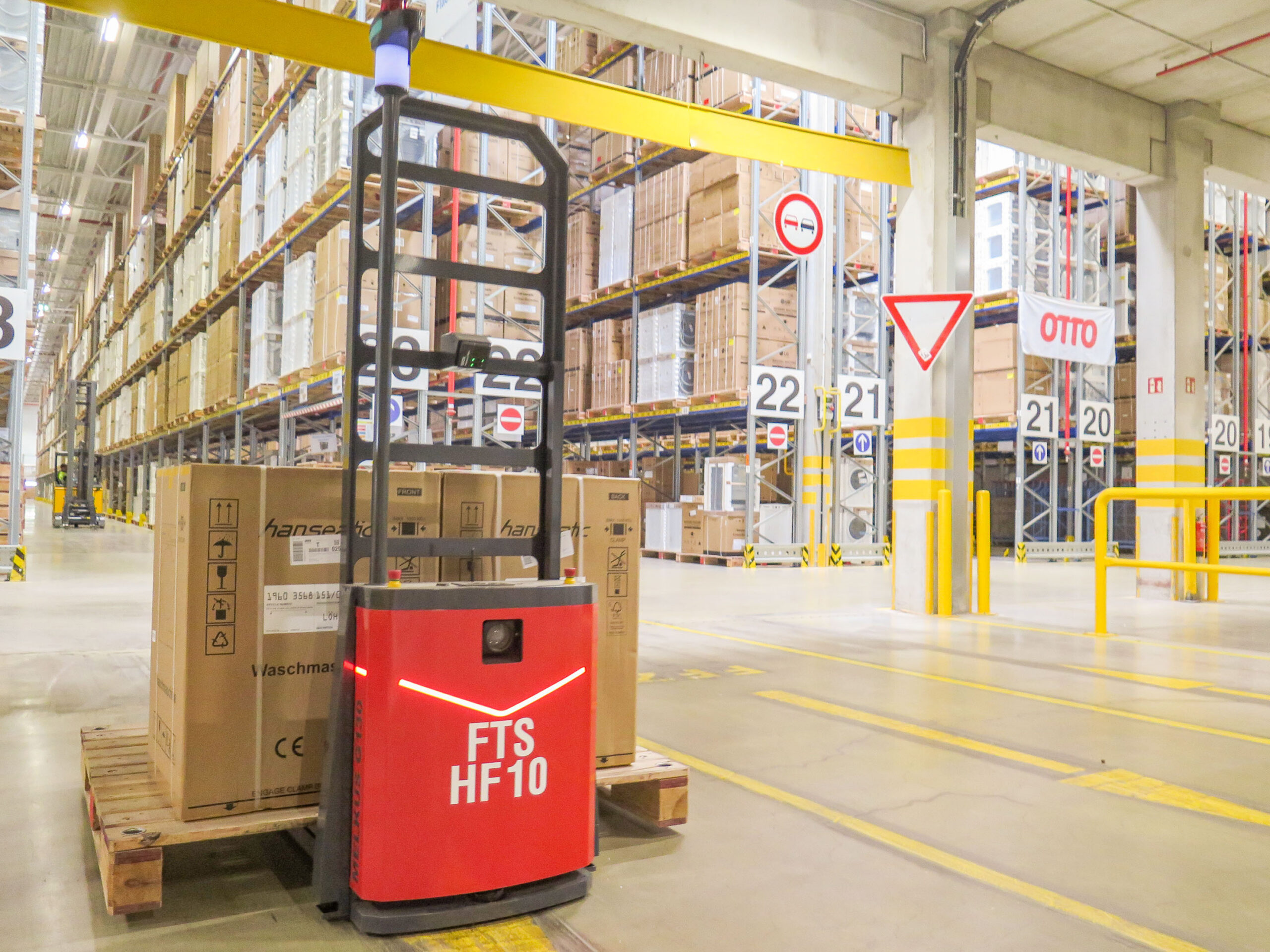
Melkus AGVs navigate using LIDAR scanners and SLAM navigation without the need for any special installations; they communicate via Wi-Fi and, thanks to their VDA5050 compatibility, can be integrated into any control system.
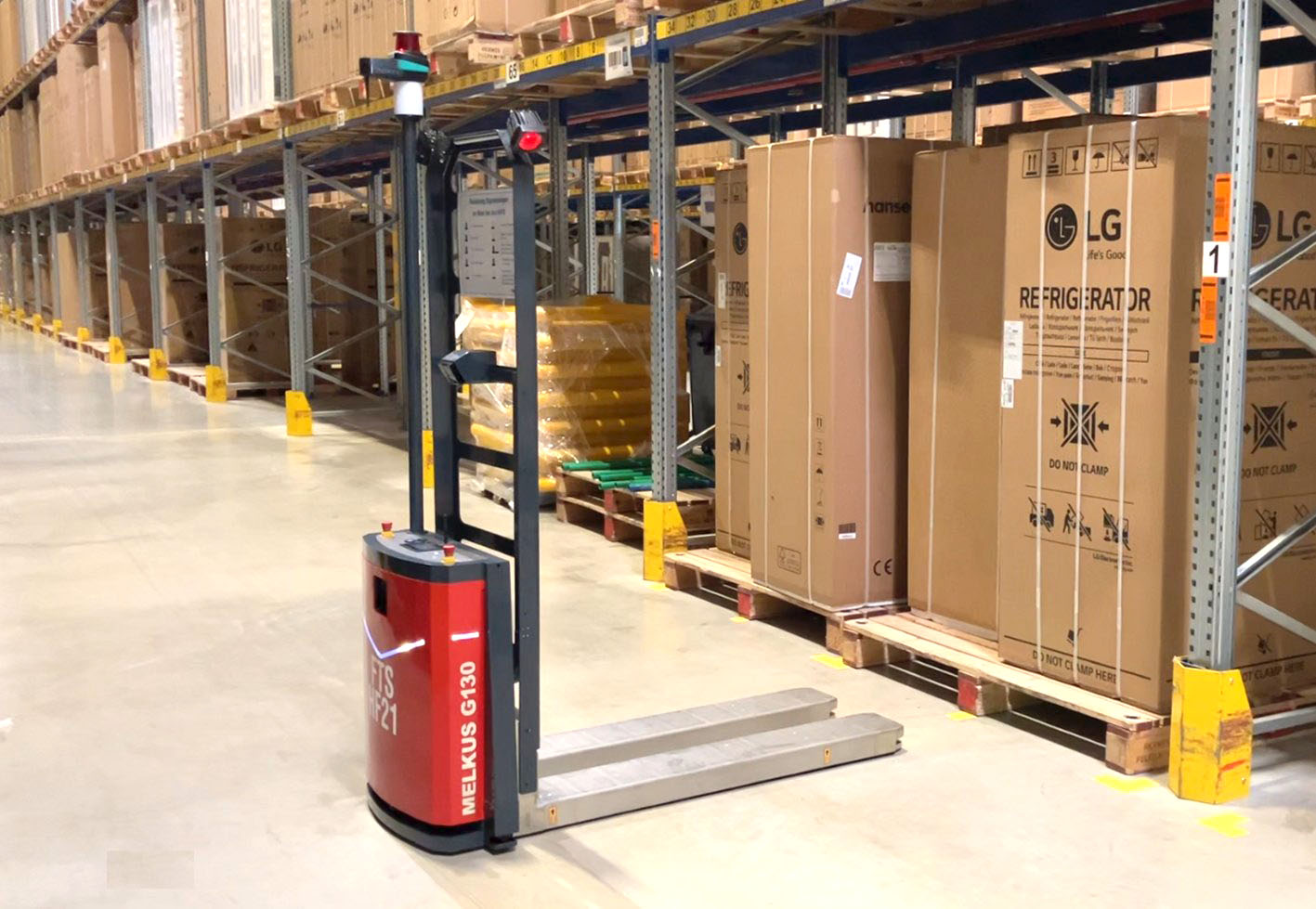
The Melkus G130 2.0 uses its omnidirectional drive system and laser scanner to position itself fully autonomously, precisely and quickly for load handling, without the need for time-consuming manoeuvring.
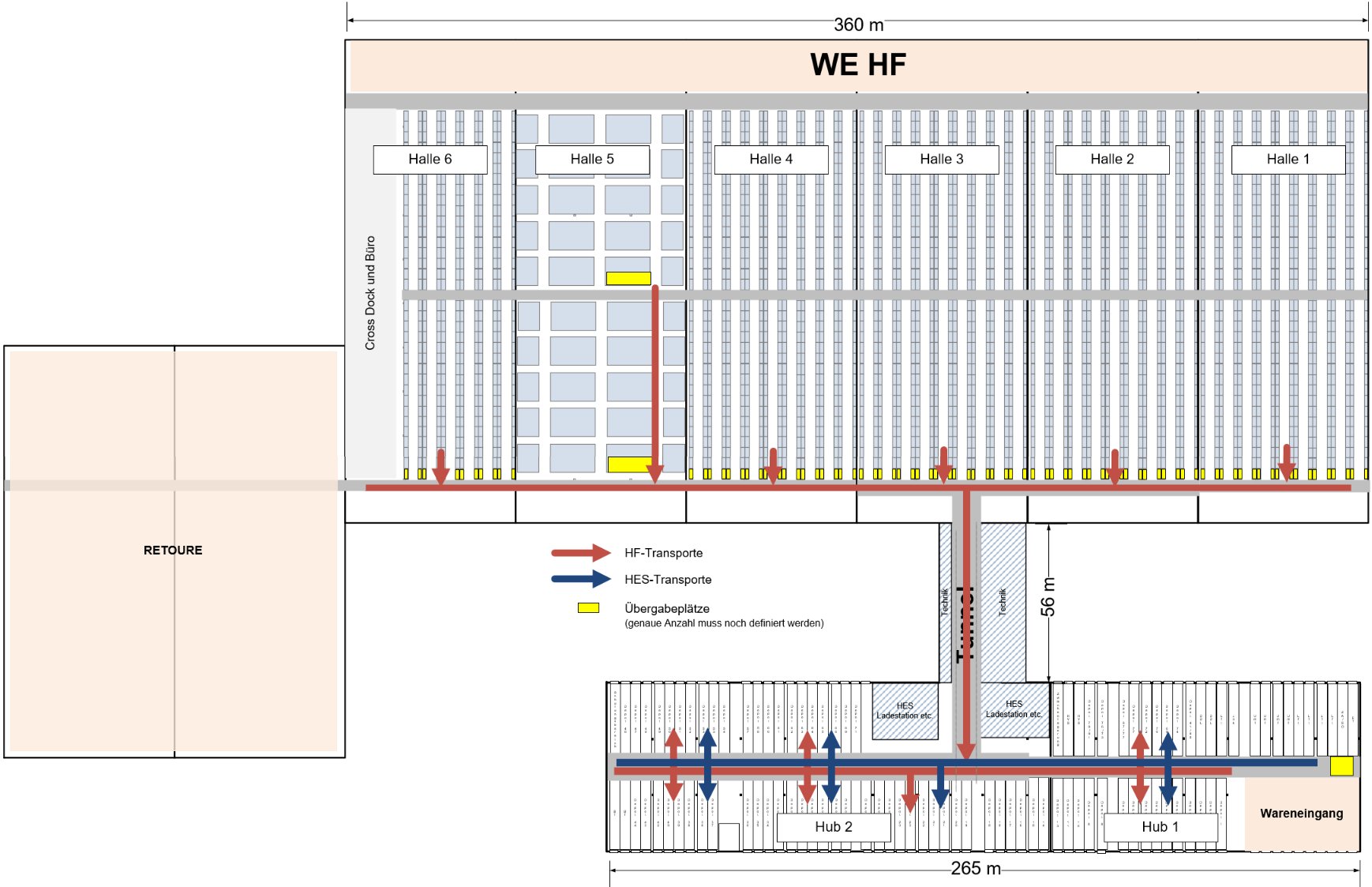
The transport routes, which are up to 600 metres long, extend across two halls belonging to the Hermes subsidiaries HF and HES, which are connected by a corridor.
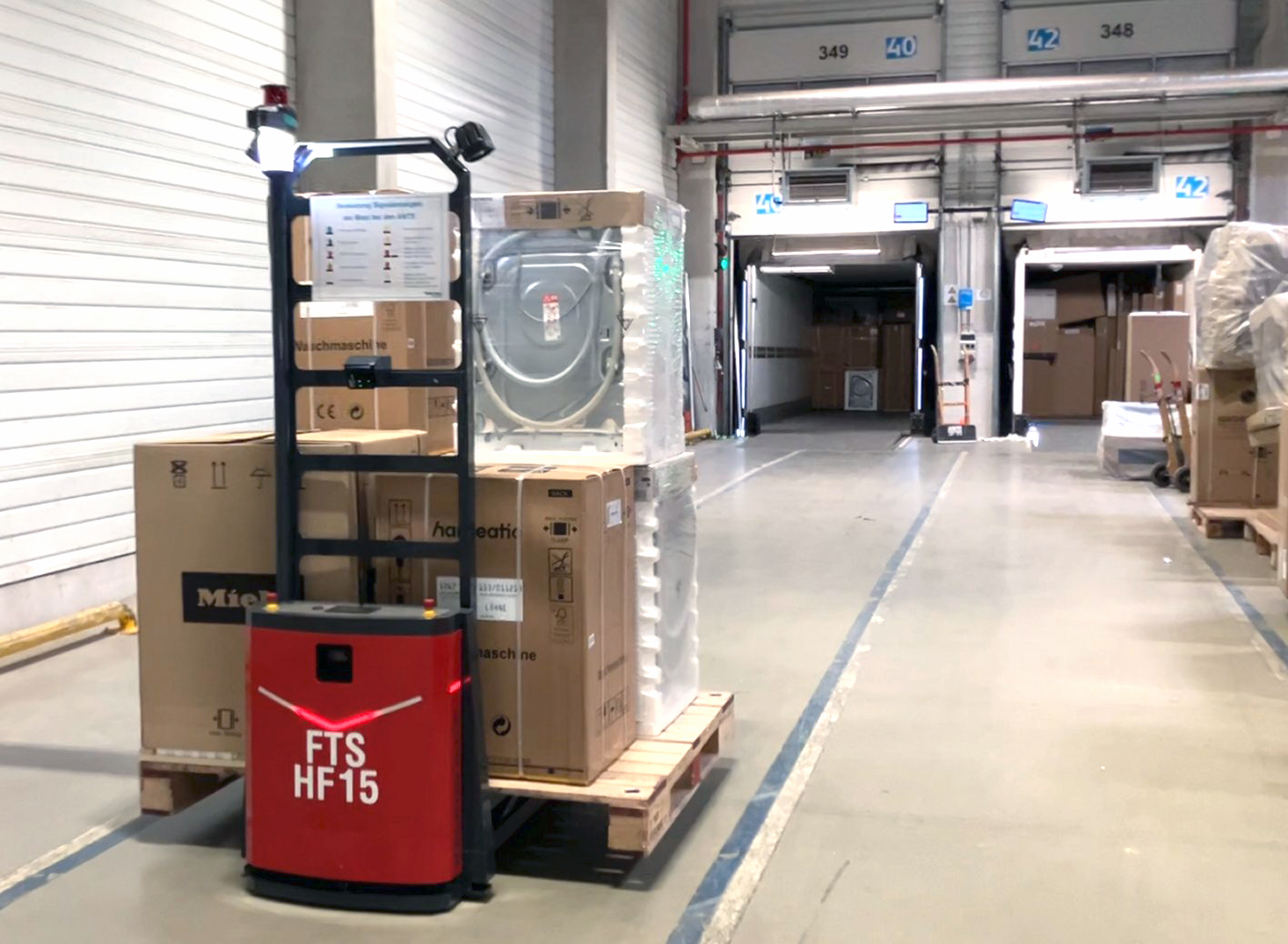
The AGVs unload their cargo at 128 lorry loading bays.